Pump Applications: Choosing the Right Technology for Efficient Production
Pumps play an important role in manufacturing, from transferring raw materials to moving finished products between processing stages.
However, not all products behave the same way.
Thin liquids, thick pastes and aggressive chemicals each require different pumping solutions. Choosing the right equipment can help manufacturers improve product handling, reduce manual work and maintain a more efficient production process.
Let’s explore three pumping technologies and how they support different manufacturing applications.
Battery-Powered Drum Pumps: Greater Flexibility in Liquid Transfer
Manufacturers often need to transfer liquids from drums and containers at different points around a facility.
Traditional electric drum pumps require access to a power supply. This can make movement between containers less convenient, especially when operators work across several transfer points.
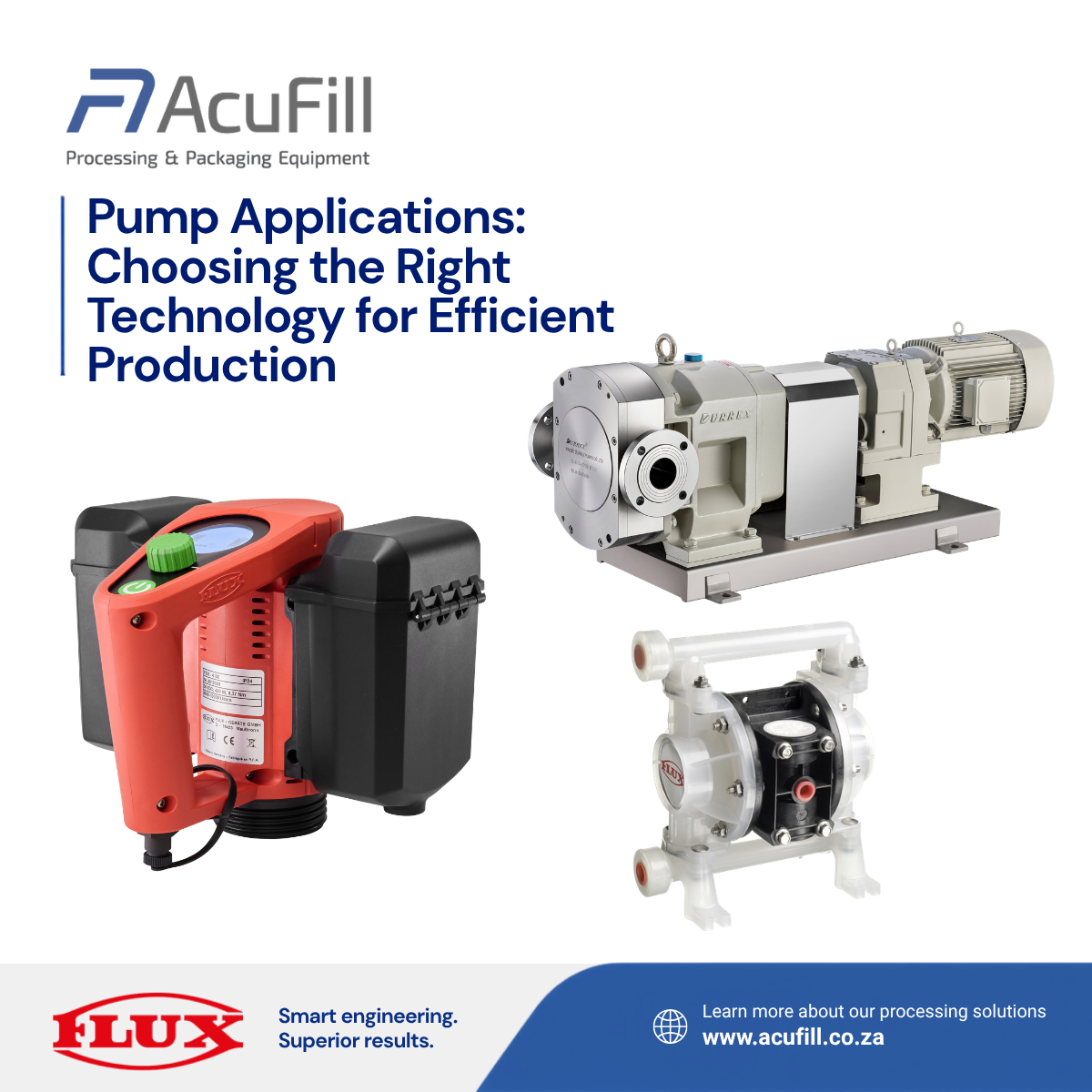
The FLUX FBM 4100 Battery Motor offers an alternative.
This cordless motor combines the performance of a conventional drum pump motor with the flexibility of battery operation, suitable for both Low and High Viscosity Liquids.
Operators can move between suitable transfer points without relying on a nearby mains connection.
The FBM 4100 also includes features that simplify everyday liquid-handling tasks:
- Integrated batch filling: Repeat filling quantities at the touch of a button without an external measuring device.
- Dry-run protection: Detects an empty container and automatically switches off the motor when the function is activated.
- Brushless motor technology: Provides maintenance-free motor operation.
These features make the FBM 4100 particularly useful for facilities that regularly move liquids between drums, containers and processing equipment.
By reducing cable restrictions and simplifying repeated transfers, manufacturers can make routine liquid handling more efficient.
Rotary Lobe Pumps: Handling Viscous Products Across Industries
Moving thick products inline require a different approach.
Chocolate, honey, syrups, sauces, creams and lotions can place greater demands on inline pumping equipment because of their viscosity and sensitivity to shear.
Durrex Rotary Lobe Pumps use positive displacement technology to transfer these products.
Inside the pump, two synchronised rotors move the product through the pumping chamber. The rotors do not contact each other, allowing controlled product transfer.
This technology suits a wide range of applications, including:
- Food and beverage: Chocolate, honey, yoghurt, syrups and sauces.
- Cosmetics and personal care: Shampoo, creams and lotions.
- Pharmaceutical manufacturing: Suitable liquid, viscous and shear – sensitive formulations.
- Chemical processing: Compatible viscous chemicals and other industrial media.
Rotary lobe pumps can provide a steady, controlled flow, making them useful when manufacturers need to transfer products between processing stages.
Their versatility also allows manufacturers to select pump configurations suited to different products, flow requirements and operating conditions.
Chemical Pumps: Matching Equipment to the Product
Chemical manufacturing involves liquids with very different properties.
Acids, alkalis, solvents, adhesives and cleaning products all require careful pump selection.
The wrong materials or pump design can lead to equipment damage, poor performance and unnecessary downtime.
FLUX offers several pumping technologies for chemical applications.
Series 400 Drum Pumps support chemical transfer from drums and containers. They are available in different materials, including polypropylene, PVDF, stainless steel and Hastelloy C.
This allows manufacturers to select a pump material compatible with the chemical being handled.
For thicker chemicals, VISCOPOWER Progressive Cavity Pumps offer another solution. Their design supports the transfer of viscous products that may be difficult to move using conventional drum pumps.
Air-operated diaphragm pumps provide an option for transferring suitable aggressive chemicals, while flow meters can support controlled filling and dosing.
The correct solution depends on the chemical, viscosity, required flow and operating environment.
Where flammable or hazardous products are involved, manufacturers must also select equipment with the appropriate safety ratings.
By matching the pump to the application, chemical manufacturers can improve liquid handling while protecting equipment and supporting safer operations.
Improving Production Starts with the Right Pump
Each pumping technology solves a different manufacturing challenge.
Battery-powered drum pumps provide flexibility when transferring liquids between containers.
Rotary lobe pumps support the controlled movement of viscous products across food, cosmetic, pharmaceutical and chemical applications.
Chemical pumps offer different materials and operating principles to suit demanding liquids and transfer requirements.
The goal is not always to choose a faster pump. It is to select equipment that handles the product efficiently and meets the required production capacity.
At Acufill, we supply FLUX PUMPS, as well as, Durrex pumping solutions for a wide range of industrial applications.
Whether you need to improve drum emptying, transfer viscous products or handle chemicals, we can help you identify the right pumping technology for your process.
Could better liquid handling improve your production efficiency?
Contact Acufill to discuss your application and find the right pump for your requirements.