Different Liquids. Different Challenges. Choosing the Right Industrial Pump.
What does transferring edible oil from an IBC have in common with circulating corrosive chemicals or pumping abrasive mining slurry?
All three require industrial pumps. But they don’t require the same pumping technology.
Across manufacturing, liquids differ in viscosity, chemical composition, temperature, hygiene requirements and solids content. These characteristics influence how a pump performs, which materials are suitable and what operating conditions the equipment can handle.
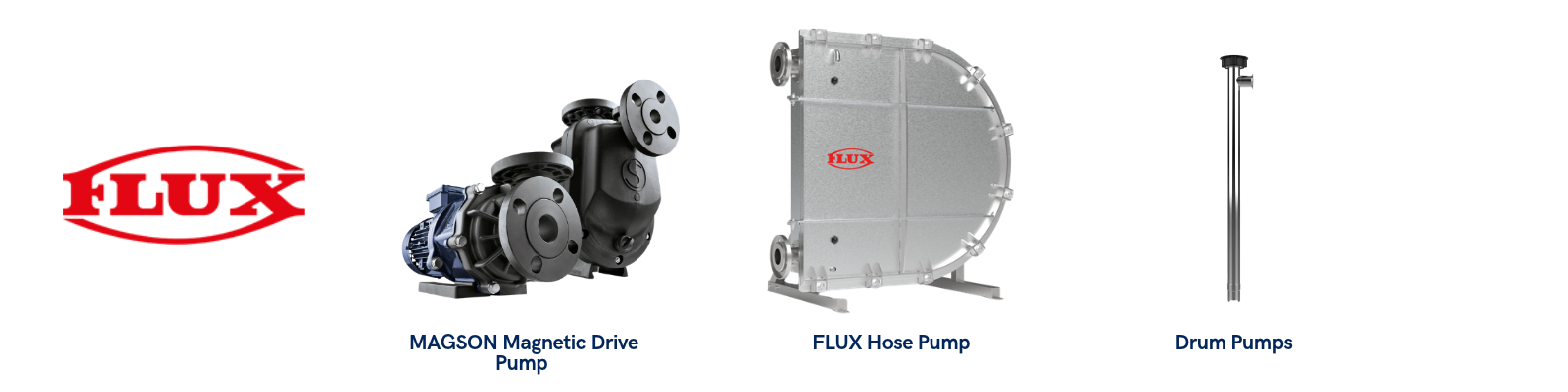
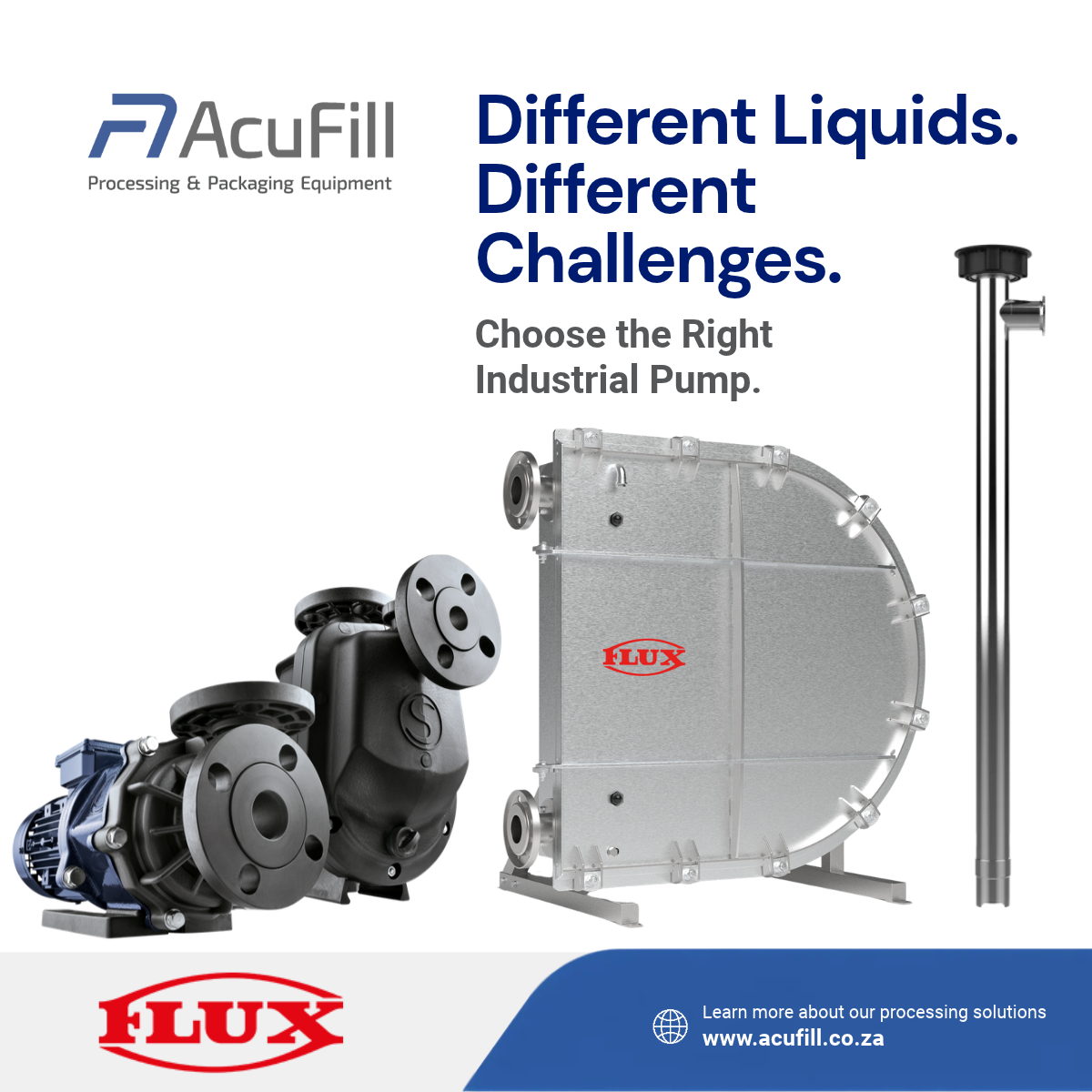
From versatile drum pumps and hygienic stainless steel designs to magnetic drive technology and heavy-duty peristaltic hose pumps, FLUX offers different solutions for different liquid-handling challenges.
FLUX Drum Pumps: Versatile Liquid Transfer Across Industries
Drums and Intermediate Bulk Containers (IBCs) are widely used to store and transport liquid raw materials.
Whether it’s a chemical manufacturer transferring ingredients into a mixing vessel, a food producer handling liquid ingredients or a pharmaceutical manufacturer working with hygiene-sensitive formulations, transferring products from containers is a common production requirement.
FLUX drum and container pumps provide a practical solution for transferring suitable liquids directly from drums, IBCs and other compatible containers.
The FLUX Series 400 range offers different pump designs, materials and motor configurations to accommodate a variety of industrial applications.
Importantly, the range includes technologies suited to different processing environments, from general industrial liquid transfer to applications requiring hygienic equipment construction and thorough cleaning.
FLUX F 430: A Versatile Pump for Everyday Liquid Transfer
The FLUX F 430 uses a mechanical seal to separate the pumped medium from the inner tube and shaft assembly.
Available in different materials and immersion lengths, the F 430 can be configured for suitable liquids and container sizes.
Applications can include the transfer of compatible chemicals, industrial liquids and process ingredients, depending on the selected construction.
For manufacturers handling different raw materials, pump tube materials, motor selection and chemical compatibility are important considerations when configuring the equipment.
FLUX F 427: 3-A Sanitary Drum Pump for Hygienic Applications
In food, dairy and pharmaceutical manufacturing, hygienic equipment design is essential to maintaining product quality and supporting effective cleaning procedures.
The FLUX F 427 Stainless Steel Drum Pump is designed for hygiene-sensitive liquid transfer, with a 3-A sanitary configuration that meets internationally recognised hygienic equipment standards.
Unlike conventional mechanically sealed designs, the F 427 has no seals in the liquid area and features minimal dead-space construction, helping reduce areas where product residues may accumulate.
Designed for Easy Cleaning and Sterilisation
One of the F 427’s key advantages is its hygienic construction.
The pump can be quickly and easily dismantled into individual components, virtually without tools, allowing thorough cleaning and appropriate sterilisation.
Its outer tube, inner tube and shaft are manufactured from stainless steel grades 1.4571 and/or 1.4581, depending on the configuration.
This construction is particularly relevant to manufacturers where effective cleaning, product changeovers and contamination control are important considerations.
Hygienic Applications Across Industries
The 3-A sanitary configuration makes the F 427 particularly relevant to suitable food and dairy processing applications, while its cleanable stainless steel design also offers advantages for pharmaceutical manufacturing processes.
The pump can handle certain liquids containing solids, including fruit juices with pulp and soups containing particulates.
These applications demonstrate that hygienic pumping requirements are not limited to clear, low-viscosity liquids.
For pharmaceutical manufacturing, the F 427 can be considered for suitable hygiene-sensitive liquid transfer operations, subject to the process’s specific material, cleaning, sterilisation and validation requirements.
A pump designed for cleaning and sterilisation does not automatically guarantee sterile product transfer. Suitability for sterile pharmaceutical processing depends on the complete equipment configuration and validated manufacturing process.
Suitable for 200-Litre Drum Applications
The F 427 is suited to emptying 200-litre drums with a 1,000 mm immersion length, as specified for this configuration.
Different compatible motor options can also be selected according to the application.
The advantage? A hygienically designed drum pump that combines 3-A sanitary compliance, minimal dead space and easy disassembly for effective cleaning.
For manufacturers working with hygiene-sensitive ingredients, the F 427 provides a specialised alternative within the FLUX drum pump range.
Configuring Drum Pumps for Different Industries
One of the strengths of the FLUX drum pump range is its versatility.
Depending on the model, pump tubes are available in stainless steel and suitable plastics, while different electric and compressed-air motor options accommodate varying operating requirements.
Pump immersion lengths can also be selected for different drums and containers.
This makes FLUX drum pumps relevant across several industries, including:
- Food and beverage: Transfer of suitable liquid ingredients, edible oils, juices and other food products using appropriate food-contact or hygienic configurations.
- Dairy processing: Hygienic transfer applications where sanitary equipment construction and effective cleaning are important.
- Chemical manufacturing: Compatible acids, alkalis, solvents and liquid additives.
- Cosmetics and personal care: Liquid raw materials used in creams, lotions and cleaning formulations.
- Pharmaceutical manufacturing: Suitable liquid ingredients and hygiene-sensitive processing applications, subject to relevant GMP and process requirements.
- General industry: Coolants, cleaning agents, oils and other compatible industrial liquids.
For every application, chemical compatibility, viscosity, hygiene requirements, operating conditions and relevant safety standards must guide pump selection.
MAGSON Magnetic Drive Pumps: When Chemical Containment Matters
Not every liquid-handling process involves emptying a drum or IBC.
In chemical manufacturing, liquids often need to circulate continuously through processing systems, treatment tanks or filtration equipment.
These applications may involve aggressive acids, alkalis or other chemicals that require careful consideration of pump materials and sealing arrangements.
Conventional centrifugal pumps commonly use a mechanical shaft seal to prevent liquid escaping where the rotating shaft passes through the pump housing.
MAGSON magnetic drive pumps take a different approach by eliminating the conventional rotating shaft seal.
How MAGSON Magnetic Drive Technology Works
FLUX MAGSON pumps use a magnetic coupling to transmit power from the motor to the impeller.
Because the drive is magnetically coupled, the pump does not require a conventional rotating shaft seal between the liquid chamber and the external motor.
This construction reduces the potential leakage paths associated with mechanical shaft seals.
The MAGSON range includes the MA and MAS series, with different materials and configurations available for specific operating requirements.
Where Are Magnetic Drive Pumps Used?
Magnetic drive pumps are particularly relevant to suitable chemical circulation and transfer applications.
Examples include:
Chemical manufacturing: Circulating compatible chemical solutions between processing tanks and equipment.
Industrial water treatment: Moving suitable treatment chemicals through circulation or transfer systems.
Metal finishing: Circulating compatible acidic or alkaline solutions used in surface treatment processes.
The benefits of magnetic drive technology are especially relevant where chemical containment and material compatibility are important.
However, the absence of a conventional shaft seal does not make a pump universally chemical-resistant.
Pump materials, liquid temperature, flow requirements and operating conditions must still be evaluated.
Magnetic drive centrifugal pumps also generally require suitable liquid conditions for cooling and lubrication and should not be assumed capable of dry running.
FHP Peristaltic Hose Pumps: Handling the Fluids That Present Bigger Challenges
Some industrial fluids are difficult to pump because they contain abrasive particles, suspended solids or materials that do not behave like conventional liquids.
Mining slurry, wastewater sludge and organic residues from biogas production are examples.
These fluids may require pumping technology capable of handling solids-containing media without exposing multiple internal mechanical components to the product.
FLUX FHP peristaltic hose pumps offer a different operating principle designed for selected demanding fluid-handling applications.
How Does a Peristaltic Hose Pump Work?
Rather than using an impeller, a peristaltic hose pump moves fluid through a flexible hose.
Rotating compression elements squeeze the hose, pushing the liquid forward as the hose returns to its original shape.
This positive displacement pumping action allows the product to remain contained within the hose.
Because the pumped medium does not pass through the pump’s mechanical drive components, the design can be advantageous for suitable abrasive, solids-containing and shear-sensitive products.
The hose itself is a wear component and must be selected and maintained according to the application.
Applications in Mining, Wastewater and Biogas
Mining and mineral processing
Mining operations frequently handle slurries containing water and abrasive mineral particles.
Peristaltic hose pumps can be used for suitable slurry-transfer and dosing applications, with hose selection and operating limits determined by the fluid characteristics.
Wastewater treatment
Wastewater facilities may need to transfer sludge, dose treatment chemicals or handle fluids containing suspended solids.
Depending on the process, peristaltic pumps offer a solution for controlled transfer or dosing.
Biogas production
Biogas facilities convert suitable organic material, including agricultural residues and food-processing waste, into renewable energy through anaerobic digestion.
These processes can involve organic slurries, fermentation residues and other solids-containing materials.
FHP hose pumps can be considered for suitable transfer applications where the fluid characteristics fall within the pump’s operating capabilities.
Three Technologies. Different Pumping Requirements.
Although all three pump types move liquids, their operating principles and intended applications differ.
| Pump Technology | Key Design Feature | Typical Applications |
| FLUX Series 400 Drum Pumps | Configurable pump designs, tube materials and motors. Includes the F 430 mechanical-seal design and the F 427 stainless steel design with a 3-A sanitary configuration, no seals in the liquid area and easy disassembly. | General liquid transfer from drums and IBCs, plus specialised hygienic applications in suitable food, dairy and pharmaceutical processes. |
| MAGSON Magnetic Drive Pumps | Magnetically coupled centrifugal design without a conventional rotating shaft seal. | Chemical circulation, surface treatment and compatible industrial liquid transfer. |
| FHP Peristaltic Hose Pumps | Positive displacement pumping through a flexible hose. | Mining slurries, wastewater sludge, biogas residues and selected dosing applications. |
Understanding these differences helps manufacturers identify which pumping principle is appropriate before selecting a specific model.
Selecting the Right Industrial Pump for Your Application
Choosing a pump involves more than comparing flow rates or selecting a familiar design.
Manufacturers should consider the characteristics of the liquid, the operating environment and the requirements of the wider production process.
For example, a general industrial liquid transfer application may be suited to a configurable drum pump such as the FLUX F 430.
A hygiene-sensitive food or pharmaceutical application may require the 3-A sanitary configuration, stainless steel construction, minimal dead space and disassembly capabilities of the FLUX F 427.
Chemical circulation may call for the seal-less containment approach of MAGSON magnetic drive technology, while abrasive slurries and solids-containing fluids may require a peristaltic hose pump.
The right pumping technology is determined by what is being transferred, how it must be handled and the conditions under which the equipment will operate.
Through our partnership with FLUX Pumps, Acufill supplies industrial liquid-handling equipment for food and beverage, dairy, chemical, pharmaceutical, cosmetic, mining and other manufacturing industries.
Whether you’re transferring raw materials, working with hygiene-sensitive ingredients, circulating process chemicals or handling difficult fluids, our team can assist in identifying suitable pumping technology for your requirements.
Explore FLUX pumping solutions through Acufill. Contact Us Today.