Pharma 5.0: The Technologies Shaping the Future of Pharmaceutical Manufacturing
What does the next generation of pharmaceutical manufacturing look like?
Smarter production systems, advanced automation, greater manufacturing flexibility and a stronger focus on local medicine production are changing the pharmaceutical industry.
These developments are closely connected to an emerging concept known as Pharma 5.0.
Building on the digital transformation associated with Industry 4.0, Pharma 5.0 places greater emphasis on combining technology with human expertise, sustainable manufacturing and resilient supply chains.
For South Africa, this conversation is particularly relevant. As the country works to strengthen its pharmaceutical manufacturing capabilities and reduce dependence on imported medicines, the technologies used throughout production will play an increasingly important role.
What Is Pharma 5.0?
Pharma 5.0 applies the principles of Industry 5.0 to pharmaceutical manufacturing.
Where Industry 4.0 introduced greater connectivity, automation and data-driven production, Industry 5.0 places additional emphasis on people, sustainability and resilience.
In pharmaceutical manufacturing, this means looking beyond production speed alone.
Advanced equipment, digital monitoring and automated systems can support repeatability, traceability and process control. However, experienced operators, engineers and quality professionals remain essential to managing production and maintaining regulatory compliance.
Rather than replacing human expertise, Pharma 5.0 aims to strengthen it through technology.
The concept can be understood through three central priorities:
Human-centred manufacturing: Using technology to support skilled personnel, improve working conditions and assist with complex production decisions.
Sustainable manufacturing: Improving resource efficiency, reducing unnecessary material losses and developing more responsible production methods.
Resilient manufacturing: Building adaptable production capabilities and reducing vulnerability to supply-chain disruptions.
Together, these priorities describe a pharmaceutical industry that is not only more technologically advanced but also better prepared for changing healthcare needs.
South Africa’s Push Towards Local Pharmaceutical Manufacturing
South Africa’s interest in strengthening domestic pharmaceutical production has gained renewed momentum.
The COVID-19 pandemic exposed the risks of depending heavily on international supply chains for essential medicines and pharmaceutical ingredients.
In response, local manufacturing has become an important part of discussions around medicine security, industrial development and healthcare resilience.
A significant development took place in August 2026, when the Council for Scientific and Industrial Research (CSIR) assumed responsibility for the second phase of South Africa’s Active Pharmaceutical Ingredient Innovation Cluster.
Supported by the Department of Science, Technology and Innovation and the Technology Innovation Agency, the initiative aims to advance locally developed technologies for manufacturing active pharmaceutical ingredients (APIs).
APIs are the components responsible for the therapeutic effects of medicines. Developing local API manufacturing capabilities can help strengthen the pharmaceutical supply chain and create opportunities for domestic production.
Another major milestone followed on 7 October 2026 with the official opening of the CSIR’s FuturePHARMA facility in Pretoria.
FuturePHARMA provides specialised infrastructure for pharmaceutical research, process development and manufacturing scale-up. Its capabilities include advanced production technologies such as continuous-flow chemistry.
Importantly, FuturePHARMA is a research and development facility rather than a conventional commercial pharmaceutical factory. Its role is to help promising technologies progress towards future manufacturing applications.
These initiatives reflect South Africa’s broader ambition to develop a more competitive and resilient pharmaceutical industry.
The Manufacturing Technologies Supporting Pharma 5.0
Advanced pharmaceutical manufacturing depends on more than digital systems and sophisticated software.
The physical equipment used to process, fill, inspect and package medicines remains fundamental.
As manufacturers develop new products or expand local production capabilities, machinery selection becomes an important part of achieving consistent quality and meeting production requirements.
Several equipment categories are particularly relevant to this transition.
Precision Mixing and Powder Processing
Many pharmaceutical products begin with powders that require controlled blending before further processing.
Ingredient characteristics, mixing intensity and batch requirements influence the selection of equipment.
Industrial mixers, blenders, mills and granulation equipment support different stages of pharmaceutical powder preparation.
For example, a V-blender may be selected for suitable free-flowing powder formulations, while high-shear granulation equipment serves applications requiring controlled granule formation.
Equipment design must account for factors such as blend uniformity, cleaning requirements and process validation.
As pharmaceutical manufacturing develops, flexible processing equipment can help manufacturers accommodate different formulations while maintaining the required quality standards.
Automated Capsule Filling and Tablet Compression
Capsule filling and tablet compression are important stages in solid-dose pharmaceutical manufacturing.
Modern capsule filling equipment offers different levels of automation, from semi-automatic machines to fully automatic production systems.
Depending on the model, features may include controlled dosing mechanisms, capsule separation and closing stations, adjustable operating parameters and automated production sequences.
Rotary tablet presses provide another example of equipment supporting precision manufacturing.
Their configurations can include multiple compression stations, adjustable compression settings and automated monitoring functions.
When correctly specified, qualified and operated, these technologies can support repeatable production while reducing reliance on manual handling.
Pharmaceutical Counting, Inspection and Packaging
Manufacturing a consistent tablet or capsule is only part of the process.
Finished products must also be counted, inspected and packaged according to their intended presentation and applicable quality requirements.
Automatic tablet and capsule counting machines can support accurate product quantities during bottle packaging.
Blister packaging equipment offers another format for solid-dose products, combining formed packaging cavities with appropriate sealing materials.
Additional equipment, including capsule polishers, de-dusters, cartoners and labelling machines, supports the preparation and packaging of finished pharmaceutical products.
Integrating these machines into a suitable production line can help manufacturers coordinate product handling and reduce unnecessary manual intervention.
Sterile Container Preparation and Filling
For sterile pharmaceutical products, container preparation introduces additional processing requirements.
Vial and ampoule washing machines are designed to remove particles and other residues before subsequent preparation stages.
Depending on the manufacturing process, washing may be followed by validated sterilisation or depyrogenation before aseptic filling.
Automatic vial washers, sterile filling equipment and container-closing systems each perform a specific function within the production sequence.
Equipment selection must therefore consider container compatibility, production capacity, cleaning and sterilisation requirements, and integration with the wider line.
These technologies illustrate why pharmaceutical automation must be supported by appropriate process design and quality controls.
What Does Pharma 5.0 Mean for South African Manufacturers?
South Africa’s pharmaceutical localisation ambitions create opportunities for manufacturers, equipment suppliers, researchers and technical specialists.
Developing domestic production capabilities requires investment in infrastructure, specialised skills and reliable processing technologies.
It also requires manufacturers to evaluate how their equipment supports product quality, manufacturing flexibility and long-term operational requirements.
For some businesses, this may involve introducing automated capsule filling or tablet compression equipment.
For others, the priority may be powder processing, sterile container preparation, inspection or packaging automation.
The appropriate investment will depend on the products being manufactured, production volumes, regulatory requirements and existing infrastructure.
Pharma 5.0 provides a useful framework for considering these decisions, but successful implementation will ultimately depend on practical engineering, skilled personnel and robust quality systems.
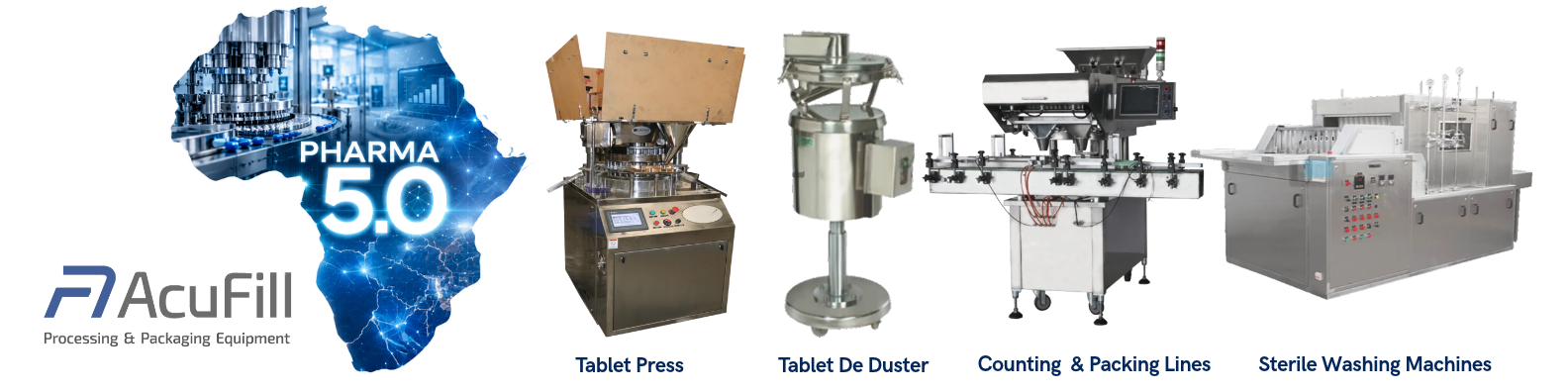
At Acufill, we supply a range of pharmaceutical processing and packaging equipment, including mixers, granulators, capsule filling machines, tablet presses, counting equipment, vial washing systems and packaging machinery.
Whether manufacturers are upgrading an existing process or developing a new production line, selecting the right equipment is an important part of building future-ready pharmaceutical capabilities.
Contact Us to explore Acufill’s pharmaceutical equipment.