Where Nutrition Meets Indulgence: New Trends in Confectionery Manufacturing
From pistachio-filled Dubai chocolate to nut, seed and fruit-based snack bars, confectionery is entering an exciting period of product innovation.
Today’s consumers are exploring two seemingly different sides of the confectionery market. On one hand, there is growing interest in snacks incorporating nuts, seeds, dried fruit and other ingredients associated with nutritional value. On the other, premium chocolate products featuring rich fillings, contrasting textures and indulgent flavours continue to attract attention.
While these trends may appear to be moving in opposite directions, they share something important: consumers are looking for more interesting products, and manufacturers need the technology to create them.
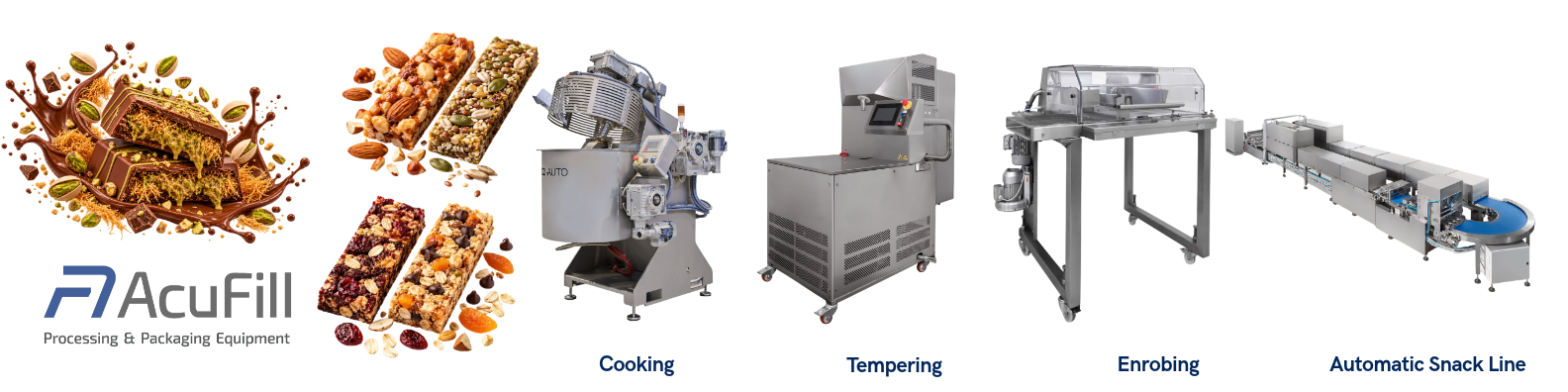
From chocolate tempering and enrobing to brittle cooking and automatic bar production, specialised confectionery equipment is helping manufacturers turn these concepts into finished products.
The Dubai Chocolate Phenomenon: Why Texture Is Taking Centre Stage
Few confectionery trends have attracted as much attention as Dubai-style chocolate.
Recognised for its rich chocolate shell, pistachio filling and crunchy kataifi pastry, the product gained international popularity through social media. Its appeal extends beyond flavour, combining contrasting textures with a visually distinctive appearance.
The trend has since inspired manufacturers to explore new combinations of chocolate, nuts, creams and crunchy inclusions.
In 2026, established chocolate brands continued introducing Dubai-inspired products, demonstrating how a viral confectionery concept can influence mainstream product development.
For manufacturers, the interesting development is not simply the popularity of pistachio chocolate. It is the opportunity to create premium products that combine multiple textures, fillings and finishing techniques.
Chocolate Tempering: The Foundation of Premium Chocolate Products
Whether producing chocolate shells, moulded bars or coated confectionery, tempering is an important stage in working with cocoa-butter-based chocolate.
Controlled crystallisation helps chocolate develop its characteristic gloss, snap and stable finish.
MIA Food Tech offers a range of continuous chocolate tempering machines, including the TM12-PRO, TM24-PRO, TM40-PRO, TM60-PRO, TM80-PRO and TM120-MAX.
These machines offer different tank capacities to accommodate varying production requirements.
For example, the TM12-PRO features a 12 kg chocolate tank, digital electronic controls and a volumetric dosing function. Larger models provide additional capacity for manufacturers working with greater chocolate volumes.
Filled chocolate bars will also require dedicated moulding, filling and cooling operations. Tempering equipment supports the chocolate preparation stage.
Chocolate Enrobing: Adding Another Dimension to Confectionery
The opportunities extend beyond moulded chocolate bars.
Chocolate enrobing allows manufacturers to apply a coating to products such as nougat, brittle, cereal bars and other confectionery centres.
MIA Food Tech’s enrobing range includes the EL180-ECO, EL200-ECO, EL200P-ECO and EL430/630-MAX systems.
Depending on the model, these systems provide different belt widths and coating configurations to suit the product being processed.
When combined with appropriate cooling equipment, enrobing can support the production of chocolate-coated snack bars, nougat pieces and premium confectionery products.
This is particularly relevant as manufacturers explore ways to introduce new flavours and textures into existing product ranges.
A traditional brittle bar, for example, can be developed into a premium chocolate-coated product without changing the fundamental identity of the confectionery.
The Other Side of Confectionery: Nuts, Seeds and Fruit-Based Bars
While premium chocolate is capturing attention, another area of product development centres on snacks incorporating ingredients such as almonds, peanuts, pumpkin seeds, sunflower seeds, oats and dried fruit.
These ingredients can provide different combinations of flavour, texture, fibre and naturally occurring nutrients.
For manufacturers, they also open opportunities to develop cereal bars, nut brittle, seed-based snacks and fruit-containing bars.
Importantly, the nutritional characteristics of the finished product depend on its complete formulation. A bar containing nuts or seeds is not automatically low in sugar or nutritionally balanced.
Nevertheless, these ingredients give manufacturers greater flexibility when developing products for different consumer preferences.
Brittle Is No Longer Limited to Traditional Peanut Recipes
Brittle is a particularly interesting example of how established confectionery products can evolve.
Traditional brittle commonly combines sugar-based binders with peanuts or other nuts to produce a firm, crunchy product.
Modern formulations can explore different combinations of almonds, cashews, sesame seeds, pumpkin seeds and other inclusions.
Manufacturing these products requires careful consideration of cooking temperatures, ingredient distribution and product handling.
MIA Food Tech’s C1, C2 and C3 AUTO high-temperature cookers are designed for brittle and energy-bar applications.
The equipment supports the preparation of suitable cooked mixtures before they move into spreading and cutting operations.
For manufacturers developing multiple brittle varieties, controlling the cooking process is particularly important because ingredient composition can influence how the mixture behaves during processing.
From Loose Ingredients to Consistent Snack Bars
Depending on the formulation, manufacturers may work with oats, puffed cereals, nuts, seeds, dried fruit and binding ingredients.
These mixtures must be formed into a consistent product before portioning.
MIA Food Tech offers several solutions for different production scales, from manual cutting tables and compact bar systems to fully automatic production lines.
Its LC 240, LC 320 and LC 420 automatic lines are designed for energy bars and brittle production.
These systems support the spreading and cutting stages, helping manufacturers produce bars with controlled dimensions.
For larger operations, MIA’s Professional SNACK BAR Line combines cooking and automatic bar-forming equipment in a configurable production arrangement.
The line is designed for approximately 5,000–8,000 bars per hour, depending on the recipe and bar dimensions, with production modules selected according to the application.
This flexibility is relevant for manufacturers developing multiple products rather than relying on a single bar formulation.
Different recipes may require different temperature settings, handling methods and cutting arrangements. Formulations containing sticky fruit components, for example, must be evaluated for compatibility with the selected equipment.
Where Nutrition and Indulgence Come Together
Perhaps the most interesting opportunity lies in combining elements of both trends.
Consider the possibilities:
A nut-and-seed brittle bar finished with a layer of dark chocolate.
A cereal bar containing dried fruit and coated in tempered chocolate.
A traditional nougat bar enhanced with pistachio pieces or a premium chocolate coating.
What makes them interesting is the way they bring together familiar confectionery products with new ingredient combinations and finishing techniques.
Connecting Cooking, Forming and Chocolate Processing
This is where a broader confectionery equipment range becomes valuable.
MIA Food Tech offers equipment for several stages of production, including high-temperature cooking, spreading, cutting, chocolate tempering, enrobing and cooling.
Depending on the product, these technologies can be selected individually or configured into a more integrated production arrangement.
A manufacturer producing cereal or brittle bars, for example, may require cooking and spreading equipment followed by automatic cutting.
If a chocolate coating is added, tempering, enrobing and cooling become additional considerations.
The advantage is the ability to evaluate machinery around the finished product rather than treating every production stage in isolation.
What Do These Trends Mean for Confectionery Manufacturers?
The popularity of Dubai-style chocolate and the development of ingredient-rich snack bars highlight how quickly confectionery concepts can evolve.
However, responding to these opportunities does not necessarily mean investing in the largest available production line.
Smaller manufacturers may benefit from compact chocolate tempering machines or semi-automatic bar-processing equipment.
Established producers may require higher-capacity systems with automated spreading, cutting and chocolate coating.
The appropriate solution depends on the product formulation, anticipated production volumes, available space and level of automation required.
Bringing New Confectionery Concepts to Production
From the crunch of a seed brittle to the smooth finish of premium chocolate, today’s confectionery trends are creating opportunities for manufacturers to rethink familiar products.
Through our partnership with MIA Food Tech, Acufill supplies specialised confectionery processing equipment for applications including nougat, brittle, cereal bars, energy bars and chocolate products.
Our range includes cooking systems, automatic spreading and cutting lines, chocolate tempering machines, enrobing equipment and associated processing solutions.
Contact Us now to learn more about our confectionery processing equipment.