Maximising Pharmaceutical Production: Is Your Equipment Ready for Increased Demand?
As the end of the year approaches, manufacturers often face a familiar challenge: increased demand.
More orders mean more products need to move through production. However, simply running equipment for longer is not always the best way to increase output.
At some point, the capacity of the equipment becomes the limiting factor.
For pharmaceutical manufacturers, this can happen at several stages. Capsule filling may struggle to keep pace. Tablet production can become a bottleneck. Even when enough product is manufactured, counting and packing can slow down the entire process.
The question is therefore not only, “How can we produce more?”
It is also, “Do we have the right equipment to produce more efficiently?”
Increasing Production Starts with Finding the Bottleneck
A pharmaceutical production line contains several connected processes.
Raw materials need preparation. Capsules need filling or powders need compression into tablets. Finished products then move through counting and packaging before they are ready for distribution.
Increasing the speed of one stage will not necessarily increase total output.
For example, a manufacturer may invest in faster capsule filling. But if the counting process cannot keep up, finished capsules simply build up before packaging.
That is why manufacturers should look at the complete production process when preparing for increased demand.
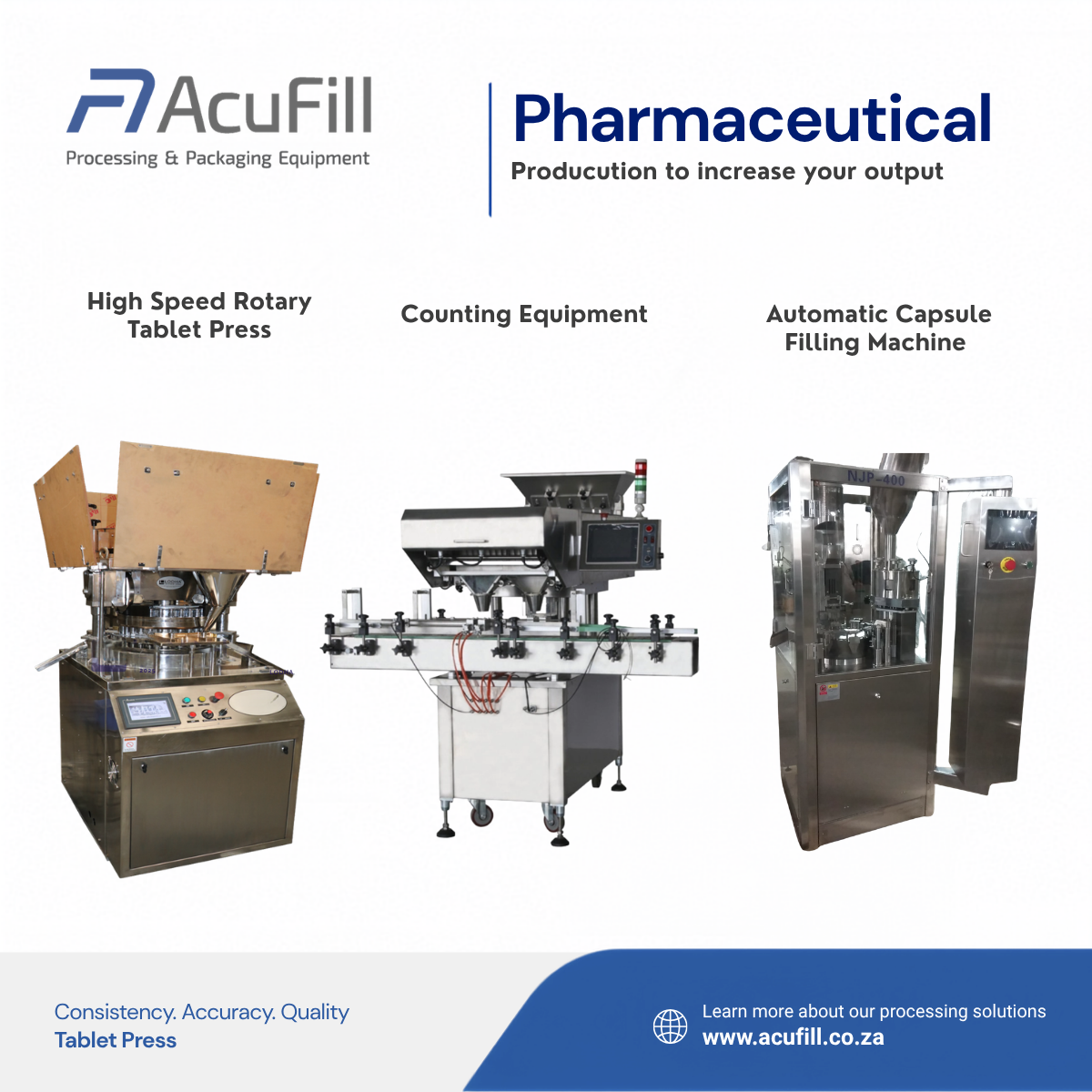
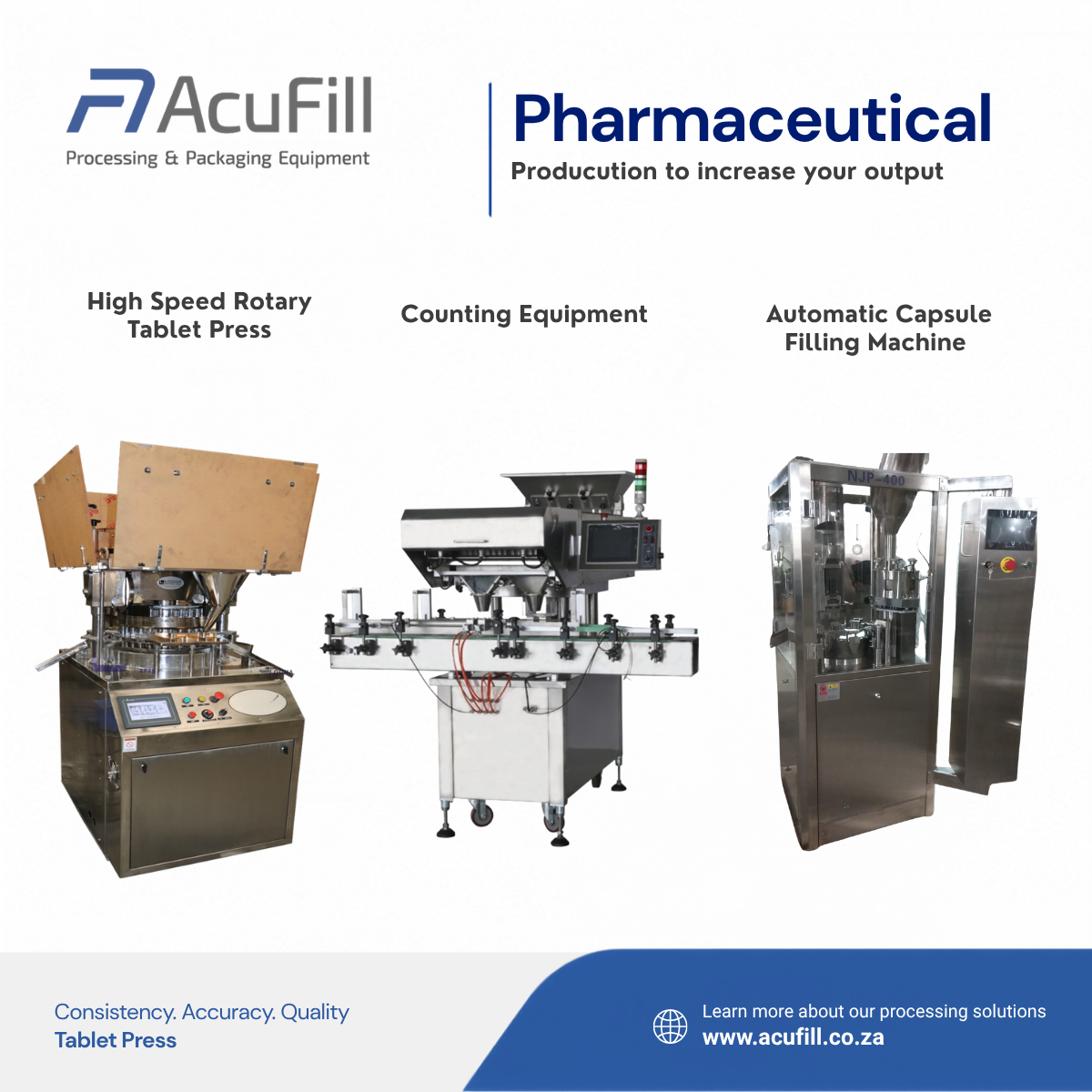
Acufill supplies pharmaceutical equipment across this wider process. The range covers powder preparation, capsule filling, tablet compression, counting, packing and cartoning.
Capsule Filling: Matching Output to Demand
Capsule production provides a good example of why equipment capacity matters.
A business producing smaller batches has very different requirements from a manufacturer producing thousands of capsules every hour.
Acufill therefore offers manual, semi-automatic and fully automatic capsule filling equipment. This allows manufacturers to select equipment based on their actual production requirements.
Semi-automatic machines provide a useful step between manual production and full automation. Our semi-automatic models range from 15,000, 25,000 and 35,000 capsules per hour.
When production requirements increase further, automation becomes increasingly important.
It may be time to then invest in fully automatic capsule fillers which can handle the capsule process from feeding and opening through to filling and closing. Our current range include machines that can operate at 25,000 capsules per hour to as high as 450,000 capsules per hour.
This range gives manufacturers room to choose equipment that matches their required output.
More importantly, it provides a path for growth.
Higher Output Still Requires Control
Speed alone should never define pharmaceutical production.
As output increases, manufacturers still need to maintain control over the process.
Acufill’s fully automatic capsule filling equipment uses PLC and touchscreen controls. The machines also operate within an enclosed working station.
This becomes particularly important during busy production periods.
The objective is not simply to manufacture more capsules. It is to increase output while maintaining a controlled and repeatable process.
That principle applies throughout pharmaceutical manufacturing.
Tablet Presses: Moving from Small Batches to High-Volume Production
The same thinking applies to tablet manufacturing.
Tablet presses convert prepared powder into tablets with the required weight, hardness and form. As demand grows, the capacity of this stage can have a major effect on overall production.
Acufill offers tablet presses for different production levels, from smaller batches through to high-volume manufacturing.
For smaller production requirements, the Single Sided Rotary Tablet Press range includes 12, 16 and 20-station options. Depending on the model, output can reach up to 52,000 tablets per hour.
For much larger production requirements, Acufill’s High Speed Rotary Tablet Press range offers 45, 61, 69 and 75-station models. The highest-capacity model listed on the website reaches up to 545,000 tablets per hour.
The high-speed range also allows operators to store recipe settings for future batches. Quick format changes and easier cleaning can further help reduce lost production time between runs.
Again, the goal is not simply to buy the fastest machine available.
The goal is to match the equipment to the required production output.
Don’t Let Counting Become the Next Bottleneck
Manufacturing the capsule or tablet is only part of the process.
The finished product still needs to reach the customer.
Once tablets or capsules leave production, manufacturers need to count the correct quantity into each bottle. As manufacturing speeds increase, manual or lower-capacity counting can quickly become a bottleneck.
This is where counting equipment becomes an important part of production planning.
Acufill offers solutions ranging from manual counters and tabletop equipment through to fully automatic counting lines. The correct solution depends on how many capsules or tablets are produced, the required quantity per bottle and the production run.
Even at tabletop level, manufacturers can choose between different capacities.
2-channel tabletop counter have a capacity of 1,000–1,800 tablets or capsules per minute. The 4-channel model increases this to 2,000–3,500 per minute.
As production requirements grow, manufacturers can move toward automated counting and packing lines.
These systems automate the counting stage and help maintain consistent output as products move toward final packaging.
This is an important point when planning for increased demand.
There is little benefit in producing capsules or tablets faster if the packaging process cannot keep up.
Think About the Production Line, Not Just the Machine
When demand increases, it can be tempting to focus on one piece of equipment.
But production capacity depends on how each stage works with the next.
Imagine increasing capsule filling capacity from 15,000 capsules per hour to 35,000. If the next stage still handles the same volume as before, the bottleneck has simply moved.
The same applies to tablet manufacturing.
A high-speed tablet press can produce hundreds of thousands of tablets per hour. Those tablets still need to move through the remaining production and packaging stages efficiently.
This is why production planning should start with the required finished output and work backwards.
How many tablets or capsules do you need per day?
How many need to go into each bottle?
Additionally, how many bottles must you pack per hour?
What is the duration of each production run?
These questions help identify where additional capacity or automation can make the biggest difference. Acufill uses the same production-based approach when specifying capsule filling and counting equipment.
Acufill specialises in capsule and tableting equipment for small to large-scale manufacturing. Our range covers the process from powder preparation through to filling, compression, counting, packing and cartoning.
As production requirements grow, the equipment should grow with them.
Preparing for increased production? Speak to Acufill about your current output, production targets and application. We can help identify equipment that matches the next stage of your manufacturing requirements.