
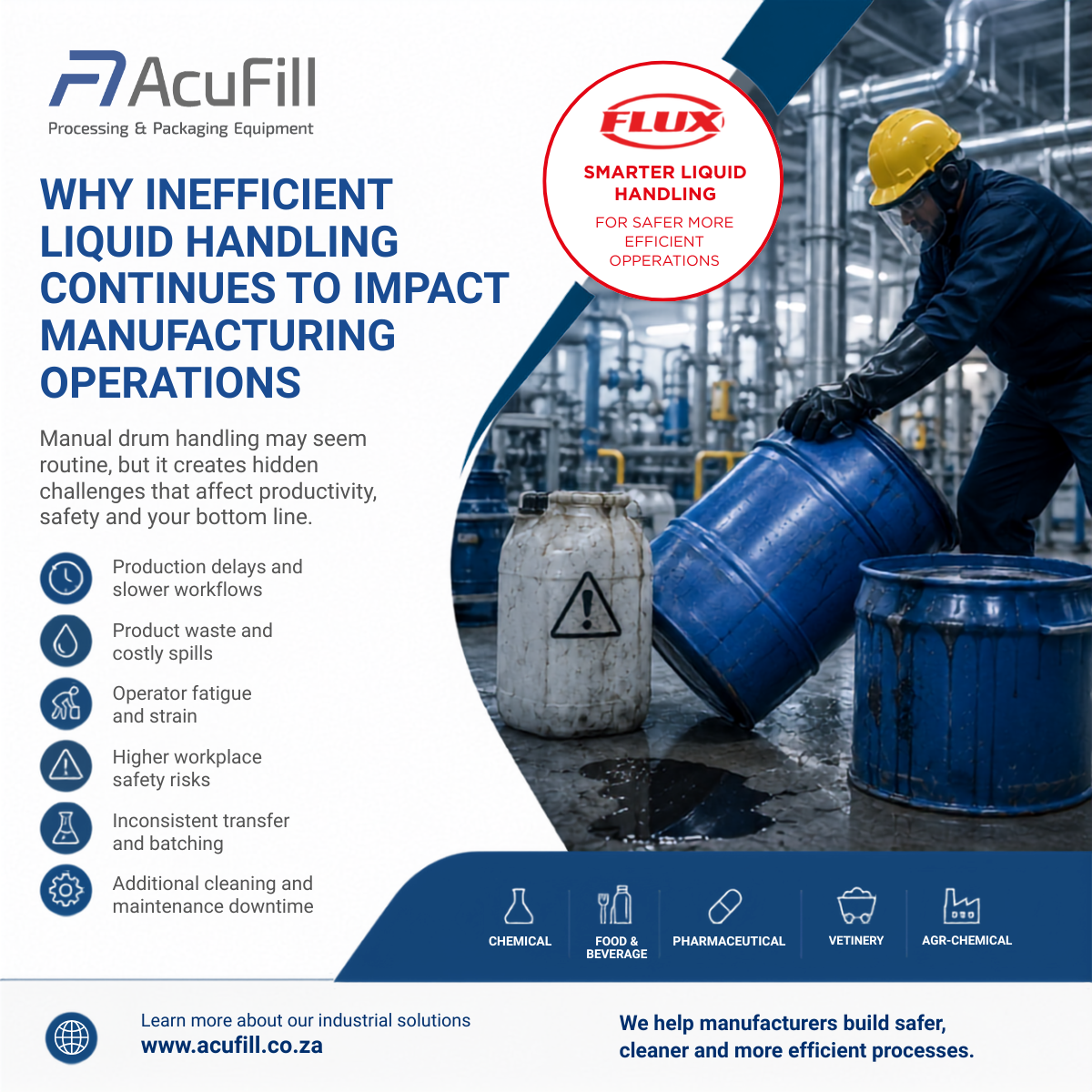
Today’s manufacturers are focused on building operations that are safer, cleaner, more reliable and capable of supporting long-term production growth.
As industries continue to modernise production facilities, many businesses are beginning to take a closer look at areas within their operations that have traditionally been overlooked. One of the most common of these is liquid handling.
Across industries such as chemical manufacturing, food production, mining and pharmaceutical processing, the movement and transfer of liquids forms an essential part of daily operations. Despite this, many facilities still rely heavily on manual handling methods that require operators to lift, tilt or pour heavy drums and containers during production processes.
Although these tasks may appear routine, inefficient liquid handling can create a range of operational challenges that affect productivity, workplace safety and overall manufacturing performance.
As production demands continue to increase, manufacturers recognise that operational efficiency is highly dependent on how materials move throughout the production environment.
The Operational Challenges Behind Manual Liquid Handling
In many facilities, manual liquid transfer processes remain part of everyday operations. Liquids are often transferred between drums, containers and processing systems using traditional methods that require significant operator involvement.
While this approach may seem manageable on a smaller scale, the long-term operational impact can become substantial as production volumes grow.
Manual handling processes frequently introduce inefficiencies that disrupt the overall production flow. Spills, inconsistent transfer rates and unnecessary interruptions can create delays that affect production schedules and place additional pressure on operators and quality control teams.
At the same time, lifting and handling heavy drums can increase operator fatigue and contribute to workplace safety risks, particularly in environments where hazardous or corrosive liquids are processed daily.
Even relatively small inconsistencies during liquid transfer can begin affecting broader manufacturing performance. In industries where batching accuracy, process stability and production consistency are critical, inefficient liquid handling can lead to avoidable downtime, increased waste and additional cleaning requirements that impact both productivity and operational costs.
For manufacturers focused on improving efficiency, these challenges are becoming increasingly difficult to ignore.
Why Liquid Transfer Efficiency Matters More Than Ever
As production processes become more advanced, every stage of manufacturing is expected to contribute to greater operational reliability and efficiency — including material handling.
Liquid transfer plays a far more important role within manufacturing operations than many businesses initially realise. When transfer processes are inconsistent or difficult to control, it can affect production stability across the entire facility.
In food and pharmaceutical manufacturing environments, liquid handling systems must support hygiene and contamination control requirements while maintaining consistent transfer conditions throughout production. In chemical and mining operations, handling aggressive or hazardous liquids safely becomes equally important.
This means that liquid transfer is no longer simply a functional process within manufacturing operations. It has become an important part of broader process optimisation strategies focused on improving safety, efficiency and operational consistency.
The Shift Towards Smarter Liquid Handling Systems
Modern manufacturing facilities are increasingly moving away from manual transfer methods and adopting more controlled liquid handling solutions designed to improve both operational efficiency and workplace safety.
One of the most effective solutions supporting this shift is modern drum pump technology.
Rather than relying on operators to manually pour or tip heavy containers, drum pump systems allow liquids to be transferred directly from drums and containers in a cleaner, safer and more controlled manner.
This creates a more stable transfer process while reducing many of the operational challenges associated with manual handling.
By improving control during liquid transfer, manufacturers are able to create smoother production workflows and reduce unnecessary interruptions across the production floor.
More controlled transfer systems also help reduce spills and overpouring, improving workplace cleanliness while minimising product waste and additional cleaning requirements.
Over time, these improvements contribute to more efficient and reliable manufacturing operations.
Supporting Safer Production Environments
One of the biggest concerns associated with manual liquid handling is operator safety.
Lifting, tilting and pouring heavy drums places significant physical strain on operators while increasing the risk of spills, splashes and workplace accidents. In environments where hazardous substances or sensitive liquids are handled regularly, these risks become even more significant.
Modern drum pump systems help reduce these challenges by minimising manual intervention during the transfer process.
Controlled transfer systems allow operators to move liquids more safely while reducing unnecessary handling, repetitive strain and exposure to hazardous materials. This supports safer working environments while helping businesses improve operational reliability and long-term workplace safety performance.
This supports an ongoing prioritisation goal of safer production facilities, and improved working conditions for staff.
Improving Process Consistency & Production Reliability
Consistency plays an important role in maintaining efficient manufacturing operations.
Inconsistent transfer processes can affect batching accuracy, material control and overall process stability, particularly in industries where precise formulations or controlled production conditions are required.
Modern drum pump systems help improve transfer consistency by creating more controlled and repeatable liquid handling processes throughout production.
More stable transfer conditions help manufacturers improve process reliability while supporting more predictable production outcomes across every batch.
Why FLUX Drum Pumps Support Modern Manufacturing Operations
In the fast paced world of manufacturing, these production environments are continually modernising and FLUX pumps are the forerunners in improving liquid handling.
FLUX Drum Pumps are designed to support safer, cleaner and more efficient liquid transfer processes by allowing controlled transfer directly from drums and containers without relying on manual pouring or tipping.
Their lightweight and modular design allows operators to handle liquids more efficiently while improving transfer control throughout production processes.
Different material options, immersion lengths and seal configurations also allow FLUX Drum Pumps to be adapted to specific liquid types, production requirements and industrial applications.
This flexibility makes them suitable across a wide range of industries, including chemical manufacturing, mining, food production and pharmaceutical processing.
By improving transfer control and reducing manual handling requirements, modern drum pump systems help manufacturers create more streamlined production environments capable of supporting both operational efficiency and workplace safety objectives.
Building More Efficient Manufacturing Processes
Manufacturing efficiency today is about far more than production speed alone.
Businesses are increasingly focused on creating operations that are more reliable, scalable and capable of supporting long-term operational performance while maintaining safer and cleaner working environments.
Material handling plays an important role in achieving these objectives.
As industries continue moving towards smarter manufacturing processes, modern liquid handling systems are becoming an increasingly valuable part of improving operational reliability and reducing unnecessary production inefficiencies.
By improving transfer efficiency, reducing manual handling and supporting more controlled production environments, modern drum pump technology is helping manufacturers build safer and more efficient operations from start to finish.
At Acufill, we work with advanced FLUX liquid handling solutions to help manufacturers improve workplace safety, operational reliability and transfer efficiency across a wide range of industrial applications.
Contact us to learn more