Protein is no longer confined to the gym.
From whey protein and creatine blends to high-protein snacks, nutritional drinks and fortified foods, manufacturers are responding to growing interest in functional nutrition.
For food producers, this creates opportunities to introduce new formulations, expand product ranges and serve changing consumer preferences.
However, different formulations place different demands on processing equipment. A free-flowing protein powder, a vitamin-enriched nutritional blend and a dense food mixture may all require different mixing conditions.
The right mixing technology depends on the ingredients, their behaviour during processing and the characteristics of the finished product.
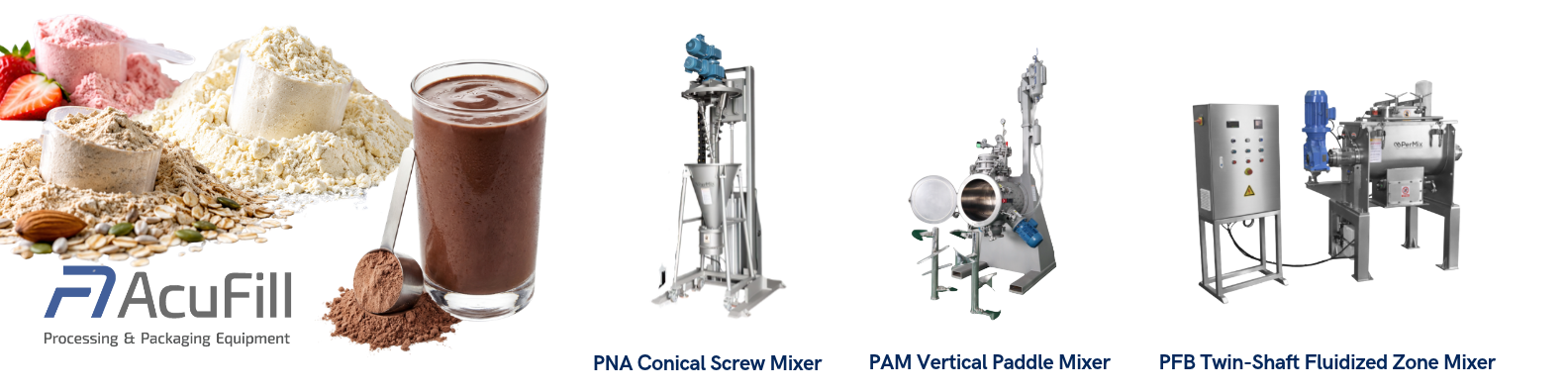
PerMix offers a range of industrial mixing technologies designed for these different requirements, including the PNA Conical Screw Mixer, PAM Vertical Paddle Mixer and PFB Twin-Shaft Fluidized Zone Mixer.
The Rise of Protein and Functional Nutrition
The popularity of protein-rich products has moved beyond traditional bodybuilding supplements.
Consumers are increasingly incorporating protein into everyday nutrition, creating opportunities for manufacturers of powdered supplements, fortified foods, meal replacements and functional ingredients.
This also introduces greater formulation complexity.
A nutritional powder may contain protein concentrates, flavourings, sweeteners, vitamins, minerals and other functional ingredients. These components can vary considerably in particle size, bulk density and flow characteristics.
For manufacturers, the challenge is to achieve the required blend uniformity while managing ingredient integrity, batch consistency and product recovery.
This is where equipment selection becomes particularly important.
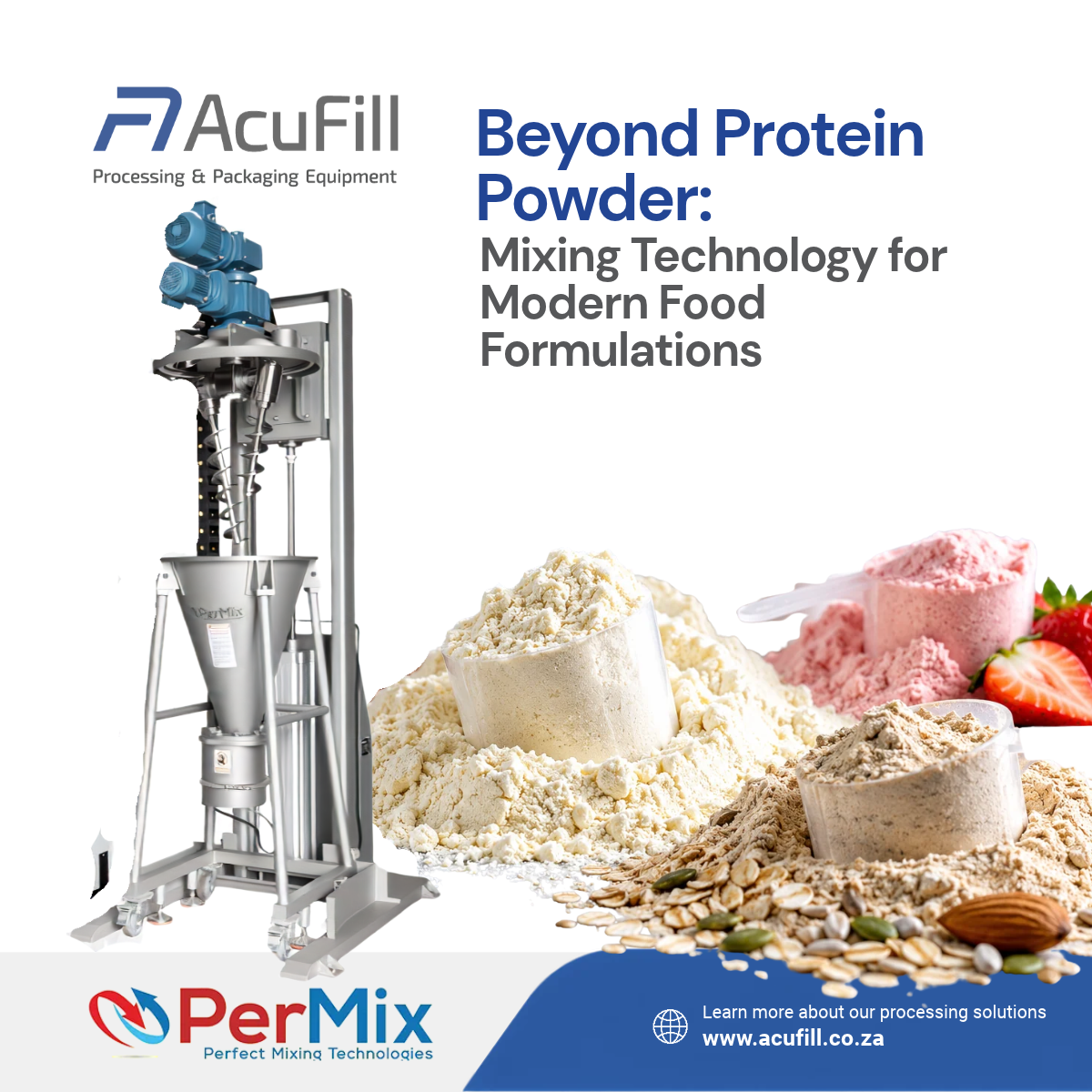
PerMix PNA Conical Screw Mixer: Gentle Blending for Nutritional Powders
The PerMix PNA Conical Screw Mixer is well suited to applications where controlled blending and gentle product handling are priorities.
Its rotating screw and orbital movement continuously lift and circulate material within the conical vessel, promoting effective ingredient distribution while limiting unnecessary mechanical stress.
This makes it an option for protein powders, nutritional supplements, food premixes and other formulations containing delicate or fine ingredients.
For manufacturers working with multiple formulations, discharge performance is another consideration. The conical design supports gravity-assisted emptying, which can help reduce retained product and simplify batch changeovers.
Depending on the selected configuration, the PNA Conical Screw Mixer can also accommodate additional processing requirements.
For nutritional manufacturers, this provides a mixing solution that can be evaluated around blend quality, ingredient characteristics and cleaning requirements.
PerMix PAM Vertical Paddle Mixer: Active Circulation and Efficient Blending
Production space, batch handling and ingredient characteristics can influence the choice of mixer just as much as mixing time.
The PerMix PAM Vertical Paddle Mixer uses a vertically mounted paddle assembly to create active product circulation within the mixing vessel.
Its mixing action continuously moves and redistributes material, promoting efficient blending and consistent ingredient distribution throughout the batch.
This combination of active circulation and controlled product handling makes the PAM suitable for a range of powders, granules and nutritional ingredients, including formulations containing components with different bulk densities.
The vertical arrangement also offers a compact equipment footprint, while gravity-assisted discharge supports product removal.
For manufacturers producing several product variants, equipment access, cleaning arrangements and discharge design should be considered alongside mixing performance.
The PAM demonstrates how effective product circulation and gentle handling can work together within a vertical mixing configuration.
PerMix PFB Twin-Shaft Fluidized Zone Mixer: Rapid Mixing with Gentle Product Handling
As nutritional formulations become more complex, achieving consistent distribution of ingredients can require a different mixing approach.
The PerMix PFB Twin-Shaft Fluidized Zone Mixer uses two counter-rotating shafts to create overlapping zones of material movement.
This fluidized mixing action promotes rapid interaction and distribution between ingredients, including powders with differences in particle size and density.
Importantly, rapid mixing does not necessarily mean aggressive product handling.
The PFB is designed to provide fast, effective blending with low shear and minimal heat generation, making it suitable for sensitive materials that require careful processing.
This combination is particularly relevant to applications such as protein blends, powdered beverages, vitamin mixes, milk powders and nutritional premixes.
The system can also be configured for controlled liquid addition where the formulation requires it.
For manufacturers handling larger batches or formulations with demanding homogeneity requirements, the PFB offers a different approach to achieving efficient blending without unnecessarily compromising ingredient integrity.
The appropriate configuration will depend on the ingredients, target blend uniformity, batch size and production requirements.
What About Sauces, Pastes and High-Viscosity Products?
The growing functional food market is not limited to dry powders.
Protein-enriched spreads, nutritional pastes, sauces and ready-to-consume products introduce additional processing considerations.
Controlled liquid addition to powders is different from processing viscous pastes. Sauces, pastes and highly viscous formulations require a separate assessment to select the appropriate PerMix technology.
For example, adding a small quantity of liquid to a powder blend may be intended to distribute a flavouring, binding ingredient or other additive throughout the dry material.
Manufacturing a thick sauce or paste, however, introduces different requirements relating to viscosity, material movement, liquid incorporation and potentially emulsification.
Some formulations require controlled dispersion to avoid agglomeration, while others may need specialised mixing or high-shear processing to achieve the desired texture.
This is why manufacturers should distinguish between dry blending, powder conditioning and high-viscosity processing.
PerMix offers different mixing technologies that can be evaluated according to these processing requirements.
The final equipment selection should reflect the product’s actual processing behaviour rather than its ingredient list alone.
Choosing the Right Mixer for Your Formulation
There is no single mixing technology suited to every nutritional or food product.
The PNA Conical Screw Mixer provides a controlled blending approach using screw-driven circulation within a conical vessel, with gravity-assisted discharge as an additional consideration.
The PAM Vertical Paddle Mixer promotes active product circulation and efficient blending within a compact vertical configuration.
The PFB Twin-Shaft Fluidized Zone Mixer combines rapid ingredient distribution with low-shear mixing and minimal heat generation, making it relevant to both demanding powder blends and sensitive ingredients.
Both vertical paddle and twin-shaft fluidized-zone technologies can provide gentle, effective blending. The right choice depends on the required product circulation, mixing time, installation constraints and formulation characteristics.
Other factors, including batch size, cleaning requirements, liquid addition and discharge arrangements, should also be evaluated.
Rather than selecting equipment based on mixing speed alone, manufacturers should consider how the technology interacts with their specific ingredients throughout the process.
Mixing Technology for the Next Generation of Food Products
Protein powders may be driving much of the current conversation around functional nutrition, but the manufacturing opportunity extends much further.
As producers introduce new nutritional blends, fortified foods and specialist formulations, mixing equipment needs to accommodate increasingly varied processing requirements.
From gentle screw-driven circulation to active vertical paddle mixing and rapid low-shear fluidized blending, different technologies offer manufacturers different ways to achieve their processing objectives.
At Acufill, we work with manufacturers to identify processing equipment suited to their ingredients, production requirements and future product development plans.
Through our partnership with PerMix, we provide access to a range of industrial mixing technologies for food, nutritional and other manufacturing applications.
Developing a new formulation or evaluating your existing mixing process?
Contact Us to explore PerMix mixing solutions and discuss your requirements with our team.