
Waste remains one of the biggest challenges facing confectionery manufacturers today. While many businesses focus on reducing ingredient costs or improving production output, waste often occurs much earlier in the process than expected.
For manufacturers producing brittle, nougat, cereal bars and other confectionery products, waste is frequently accepted as an unavoidable part of production. However, many of the losses experienced on the factory floor are not caused by the product itself. They are created by inefficient processing methods, inconsistent production conditions and equipment that is not designed for the application.
As manufacturers continue to pursue higher production volumes and improved profitability, reducing waste has become an important part of maintaining competitiveness. The challenge is identifying where those losses occur and implementing processes that deliver greater consistency from start to finish.
Waste Often Begins Long Before Packaging
When manufacturers think about waste, they often focus on damaged products, trimming losses or rejected batches at the end of the production line. In reality, waste can begin much earlier.
Every stage of brittle and snack bar production influences the final yield. Mixing, cooking, product handling, forming and cutting all contribute to product quality and manufacturing efficiency.
If one of these stages is not properly controlled, waste can quickly accumulate throughout the process.
In many facilities, production systems have evolved over time as demand has increased. New products are introduced, production volumes grow and processes are adapted to meet customer requirements. Unfortunately, equipment that once performed adequately may no longer support the consistency required for modern production environments.
As a result, manufacturers often experience losses that become accepted as normal operating conditions when they are actually preventable.
Why Consistency Plays Such a Critical Role
Consistency is one of the most important factors in confectionery manufacturing.
Customers expect every brittle piece, nougat bar or snack bar to deliver the same appearance, texture and quality. Variations in product size, ingredient distribution or cooking performance can affect both customer perception and production efficiency.
Achieving this level of consistency requires stable processing conditions throughout the manufacturing process.
Mixing is often one of the first areas where problems emerge.
When ingredients are not distributed evenly, manufacturers may experience product variability across batches. Certain sections of a product may contain higher concentrations of ingredients while others contain less. This can affect texture, flavour and overall product quality.
Inconsistent mixing can also create additional production challenges. Operators may need to rework batches, increase processing time or use more material to compensate for quality variations. These actions increase production costs while reducing overall efficiency.
For manufacturers focused on reducing waste, improving consistency during the early stages of production is often one of the most effective opportunities for improvement.
The Hidden Cost of Product Recovery
Cooking and product handling can create another significant source of waste.
Traditional production systems often require operators to manually remove product from cooking vessels once processing has been completed. This approach not only increases labour requirements but can also leave valuable product behind inside the equipment.
Over time, these losses can become substantial.
The challenge becomes even greater when processing sticky or difficult-to-handle confectionery products. Manual scooping and decanting methods rarely achieve complete product recovery. The result is wasted product, increased cleaning requirements and longer production cycles between batches.
For manufacturers producing high volumes of brittle, nougat or snack bars, improving product recovery can have a direct impact on both profitability and operational efficiency.
Reducing the amount of product left behind in processing equipment allows businesses to maximise yield while reducing unnecessary waste.
Why Cutting Accuracy Matters
Cutting is another critical stage that is often underestimated.
Poorly designed cutting equipment can create excessive trim waste, damaged products and inconsistent portion sizes. Even small inaccuracies can have a significant impact when repeated across thousands of products every day.
Inconsistent cutting also affects product presentation and customer expectations. Products that vary in size or appearance may fail to meet quality standards, resulting in additional waste and reduced yield.
As production volumes increase, these small inefficiencies can quickly become major operational costs.
Designing Equipment Around the Product
One of the most effective ways to reduce waste is to ensure that production equipment is designed around the product being manufactured.
Brittle, nougat and snack bars each have unique processing requirements. Differences in texture, viscosity, ingredient composition and handling characteristics mean that a one-size-fits-all approach often creates unnecessary inefficiencies.
This is where specialised confectionery equipment can make a measurable difference.
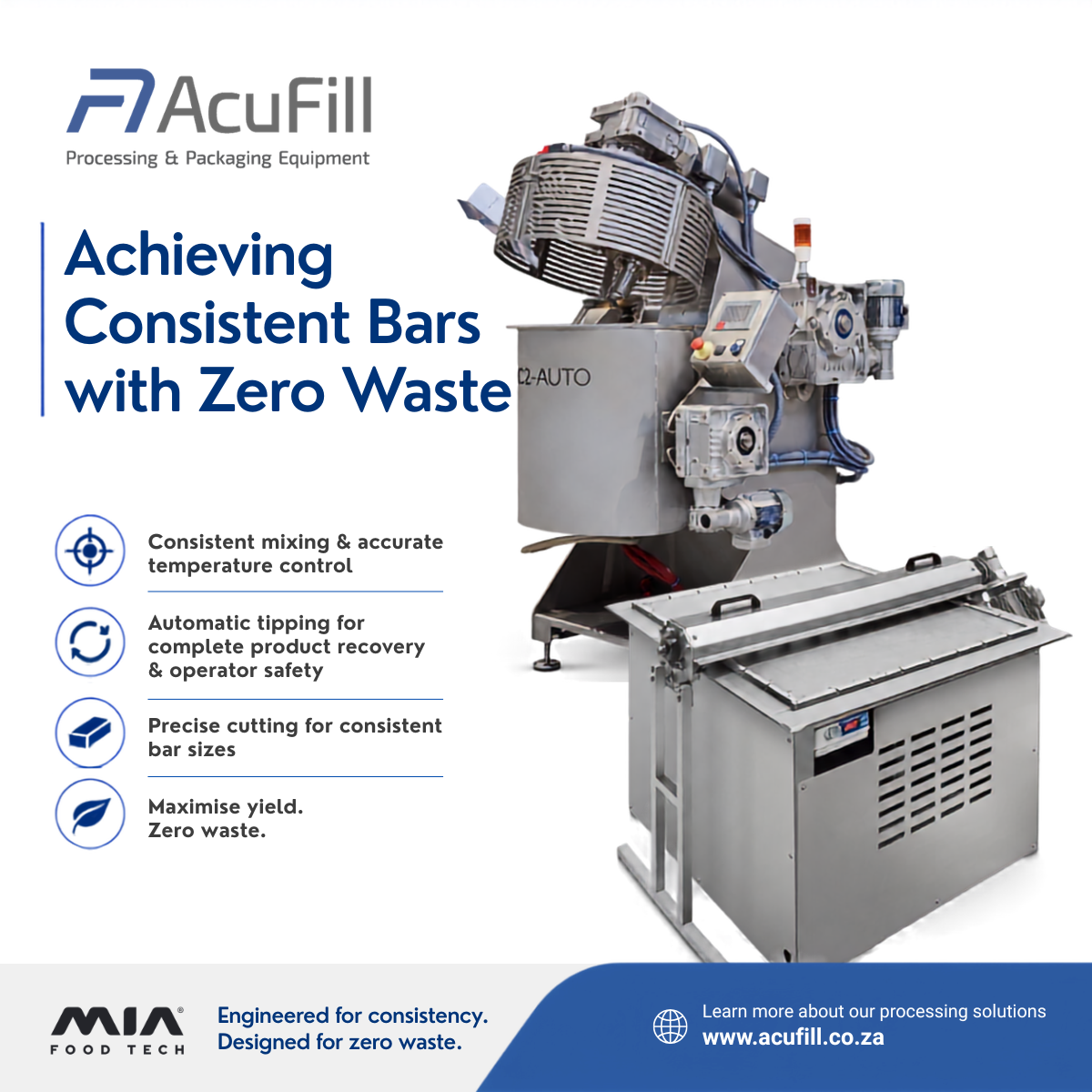
MIA Food Tech’s brittle cooker range, including the C1, C2 and C3 models, has been developed specifically to support consistent confectionery production.
The systems provide controlled mixing and accurate temperature management throughout the cooking process. Maintaining stable processing conditions helps manufacturers improve product consistency while reducing the variability that often leads to waste and rejected batches.
The equipment also supports improved product recovery. Rather than relying on operators to manually scoop product from the vessel, the cooking tank automatically tips for unloading. This allows manufacturers to recover more finished product while reducing labour requirements and minimising product left behind in the system.
Achieving Consistent Bars with Zero Waste
Once the product has been produced successfully, maintaining consistency through the final stages of production remains equally important.
MIA’s brittle cutting systems are designed to deliver precise and repeatable cutting performance, allowing manufacturers to produce products to exact specifications.
Accurate cutting helps eliminate the trim losses and inconsistencies commonly associated with conventional cutting methods. Products are cut to the required dimensions while maintaining consistency across every batch.
For brittle manufacturers in particular, this approach can deliver a genuine zero-waste outcome by ensuring the product is formed and cut to maximise yield from every production run.
The result is not only less waste but also improved product consistency, reduced rework and greater operational efficiency.
Building More Efficient Confectionery Production Processes
Reducing waste is about far more than simply recovering product.
It requires manufacturers to examine every stage of the production process and identify where losses occur. In many cases, waste can be traced back to inconsistent processing conditions, poor product recovery or inaccurate cutting methods rather than the ingredients themselves.
By focusing on consistency throughout mixing, cooking, handling and cutting, manufacturers can significantly improve production efficiency while reducing unnecessary product loss.
Modern confectionery equipment plays a critical role in achieving these goals. When equipment is designed around the product being manufactured, businesses can improve yield, reduce waste and create more reliable production processes.
At Acufill, we work with MIA Food Tech to provide advanced confectionery processing solutions that help manufacturers improve consistency, maximise product recovery and reduce waste across brittle, nougat and snack bar production environments.
Contact us to learn more.